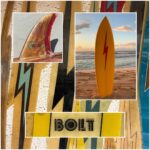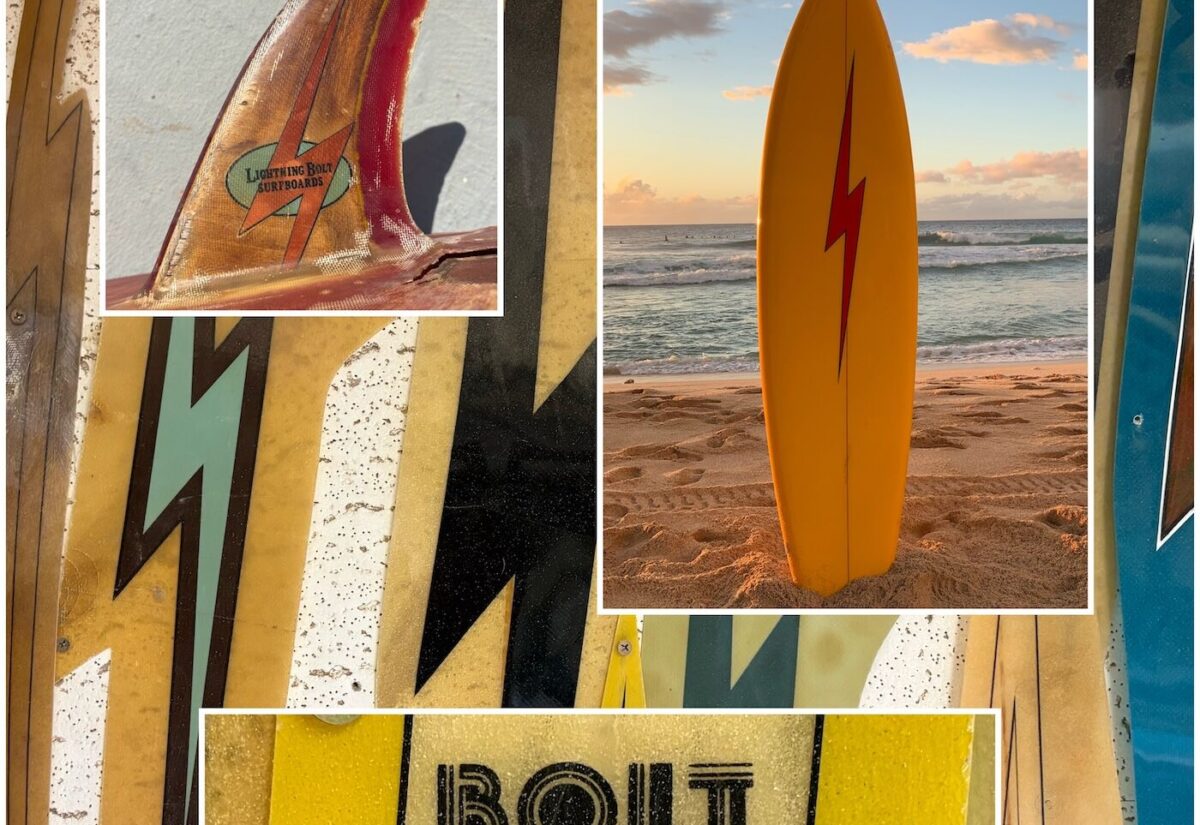
Inarguably the most co-opted symbol in surf culture is the lightning bolt. The zigzag has been so painfully bastardized by faux-vintage brands like Aviator Nation that it’s in danger of joining American icons Kleenex, Xerox, Band-Aid, and Thermos as yet another victim of genericization.
How exactly did the symbol come to grace the deck of the most defining label of the shortboard revolution? In an exclusive interview with Surf Museum Hawaii (SMH), Lightning Bolt Surfboards co-founder Gerry Lopez shed light on how the Bolt came to be:
Had Lopez known that the symbol would strike such an affecting chord when he left Surf Line Hawaii to start Lightning Bolt in 1970 with Jack Shipley, a lot of fuss could have been avoided. David Bowie may have had to scrub his face. The issue, is that while Lopez and Shipley trademarked the name, they did not trademark protect the symbol. To be fair, it may not have been possible given that it was not exactly an artistic invention. The earliest, most consistent depiction of the interchangeable thunderbolt / lightning bolt was found in the hands of the ancient ruler of Mount Olympus. An all powerful Zeus wielded the κεραυνός on Greek coins that were used in Olympia between 432–421 BC, and then again in the northwestern region of Greece, Epirus, circa 234 BC. It appeared once more in Roman sculpture around the 2nd Century AD. And like with the very first surfboard logo, a pre-WW-II swastika, the lightning bolt was also adopted by the Nazi party after Walter Heck designed a double-bolt version for the Schutzstaffel (SS) in 1929. After a brief cooling-off period, similar versions popped-up in the mid-20th Century within the DC and Marvel universe. Variations splashed across the chests of Captain Marvel, Electro, Shazam, The Flash, and other unitard wearing super-humans.
But we digress.
Despite debating who lays claim to the lightning bolt symbol, we can instead draw attention to the currently contentious topic of who owns Lightning Bolt Surfboards, or more aptly – who has the right to shape surfboards under the label. This question has volleyed around surf culture ever since Lopez released his very last shares of the company (Lightning Bolt Corporation) in 1980. The answer certainly can’t be found on the Lightning Bolt USA website, which details a nauseating narrative of peace, love, and harmony. On the flip side, is a disgruntled Rory Russell, a former Lighting Bolt teamrider, who has recently thrust the Lighting Bolt Surfboards story into the spotlight once more.
Somewhere around mid-2025, Rory checked his aloha at the door when he went on a diatribe against practically any surfboard shaper who finished their boards with a Bolt on the deck. Switching back and forth between first person and third person, he lambasted one in particular, although others have since joined the clan of Russell’s unworthy:
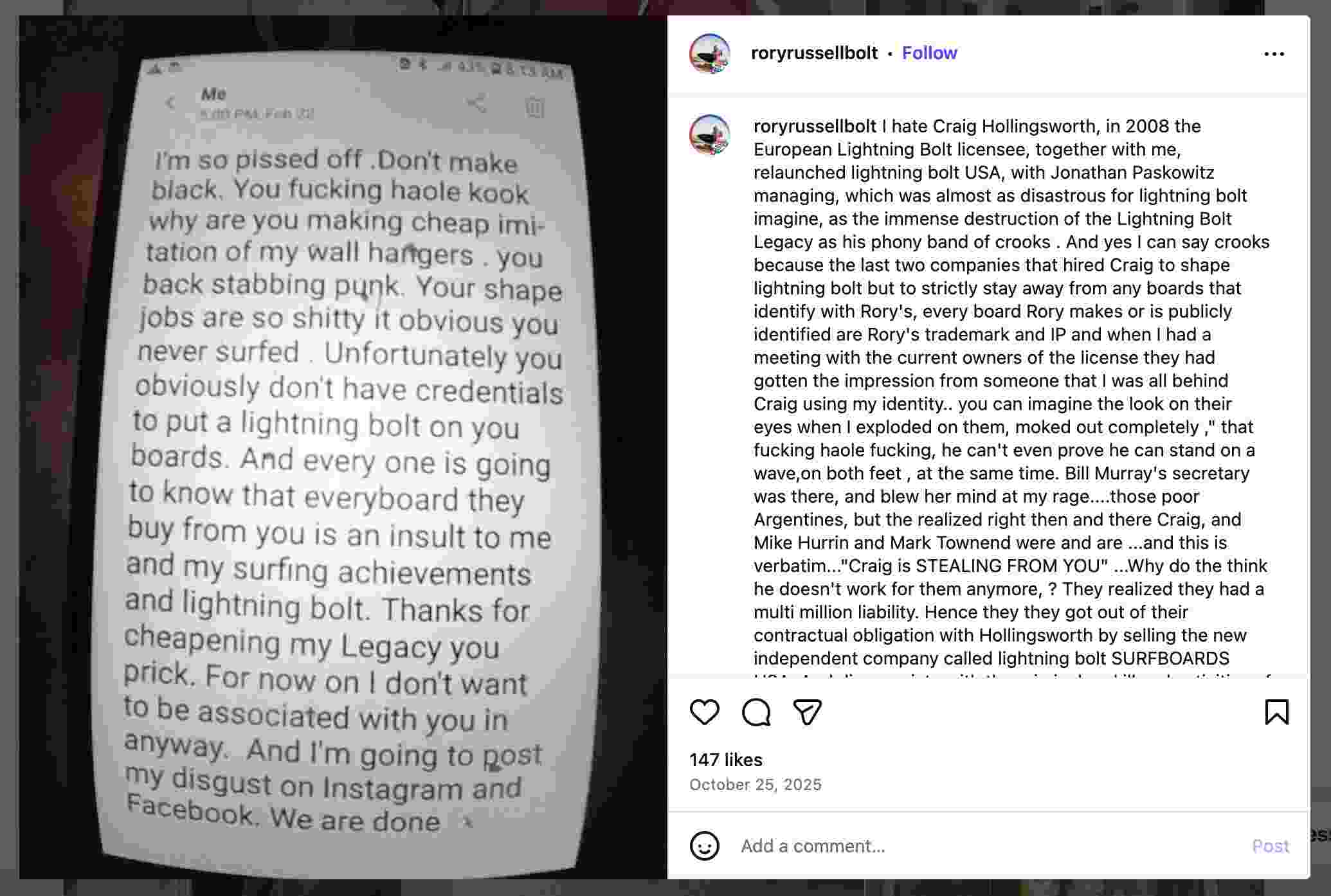
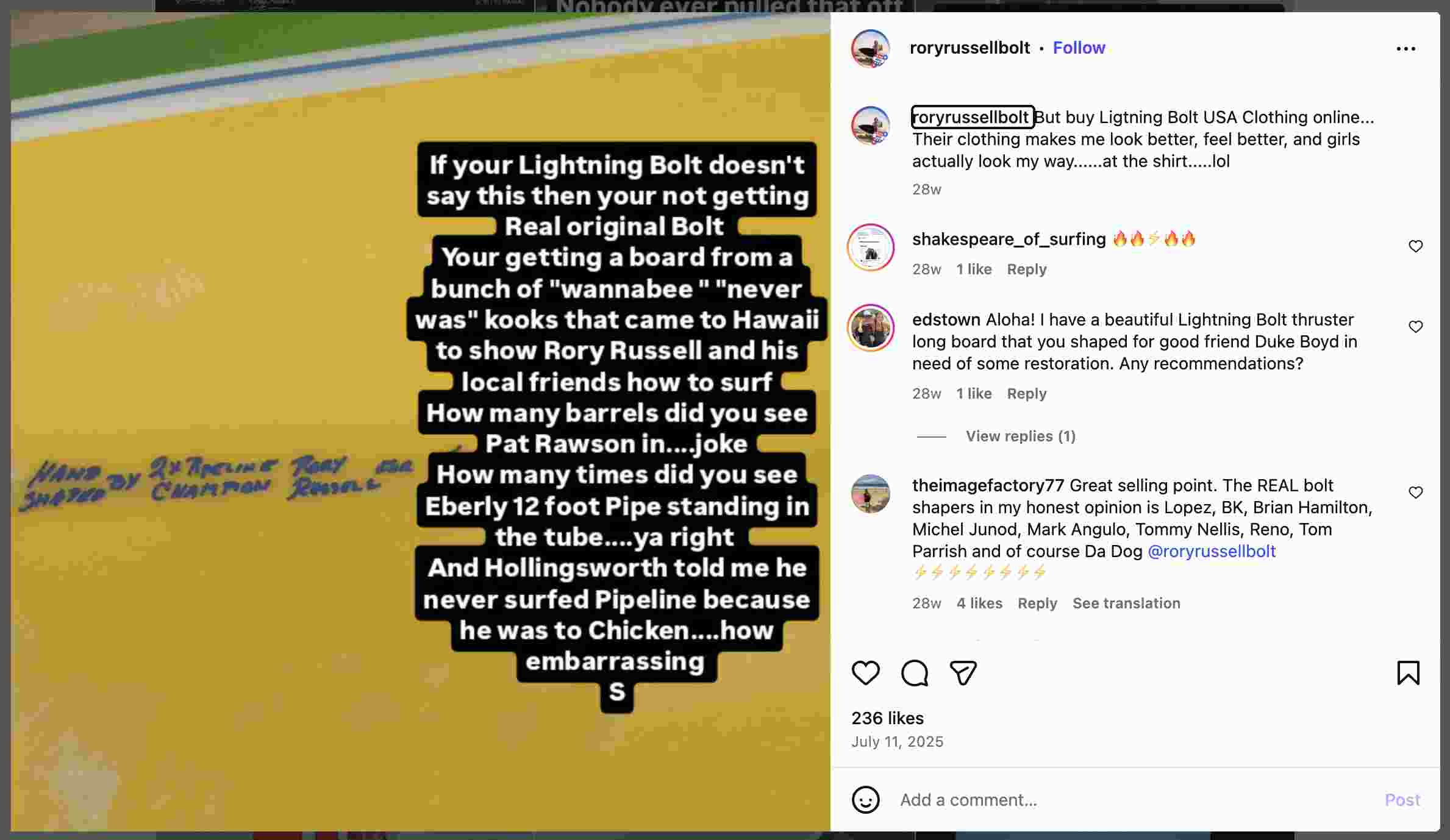
Has shaking a fist for kids to stay off his lawn so obscured Russell’s view that he can’t see the forest for the trees? Or is he righteous in his campaign to claim sole ownership of the right to hock Bolts in this millennia? What about the other Bolt wielding builders and shapers who have weighed in on the matter through the years? To get to the bottom of the debacle, we’ve gone through the timeline of Lightning Bolt Surfboards since inception through to the current inflection point. Most importantly, we draw attention to the words and spirit of the man who is responsible for bringing the Bolt to life.
Overview of Lightning Bolt Surfboards and Who Now Has the Right to Use the Name and Logo
Timeline of Lightning Bolt Surfboards Ownership and Licensing Rights
1970: Lightning Bolt Surfboards Founded
Gerry Lopez and Jack Shipley left Surf Line Hawaii to start Lightning Bolt Surfboards in the summer of 1970. They took over the building and lease from Hobie Surfboards (the first surf shop in Hawaii) on Kapiolani Boulevard. During the initial phase, Lighting Bolt Surfboards shapers were designated into three units, with prices inferring craftsmanship, although each shaper evolved over time at their own pace. An original order form provided by Randy Rarick (who also shaped a fair share of Bolts in the 70s) details which board builders were featured in each unit:
Unit 1: Gerry Lopez, Reno Abellira, Barry Kanaiapuni, Tom Parrish, Jeff Hakman, Owl Chapman, Don Koplein, Price $190. Included are color on both sides, choice of bolts, overall dimensions, tail design and rail shape.
Unit 2: Rory Russel, Brian Hamilton, Tom Eberly, Peter Trombly, Wayne Santos, Robbie Burns, Cowan Chang, Billy Barnfield. Niark Angell. Price $175. Included are color on both sides, choice of bolts, overall dimensions, tail design and rail shape.
Unit 3: Steve Walden, Russel Kim, Tom Nellis, Brian Hinde, Joe Blair, Bill Stonebreaker, Tony Anjo, John Carper. Price $160. Included are color on both sides, choice of bolts, overall dimensions, tail design and rail shape.
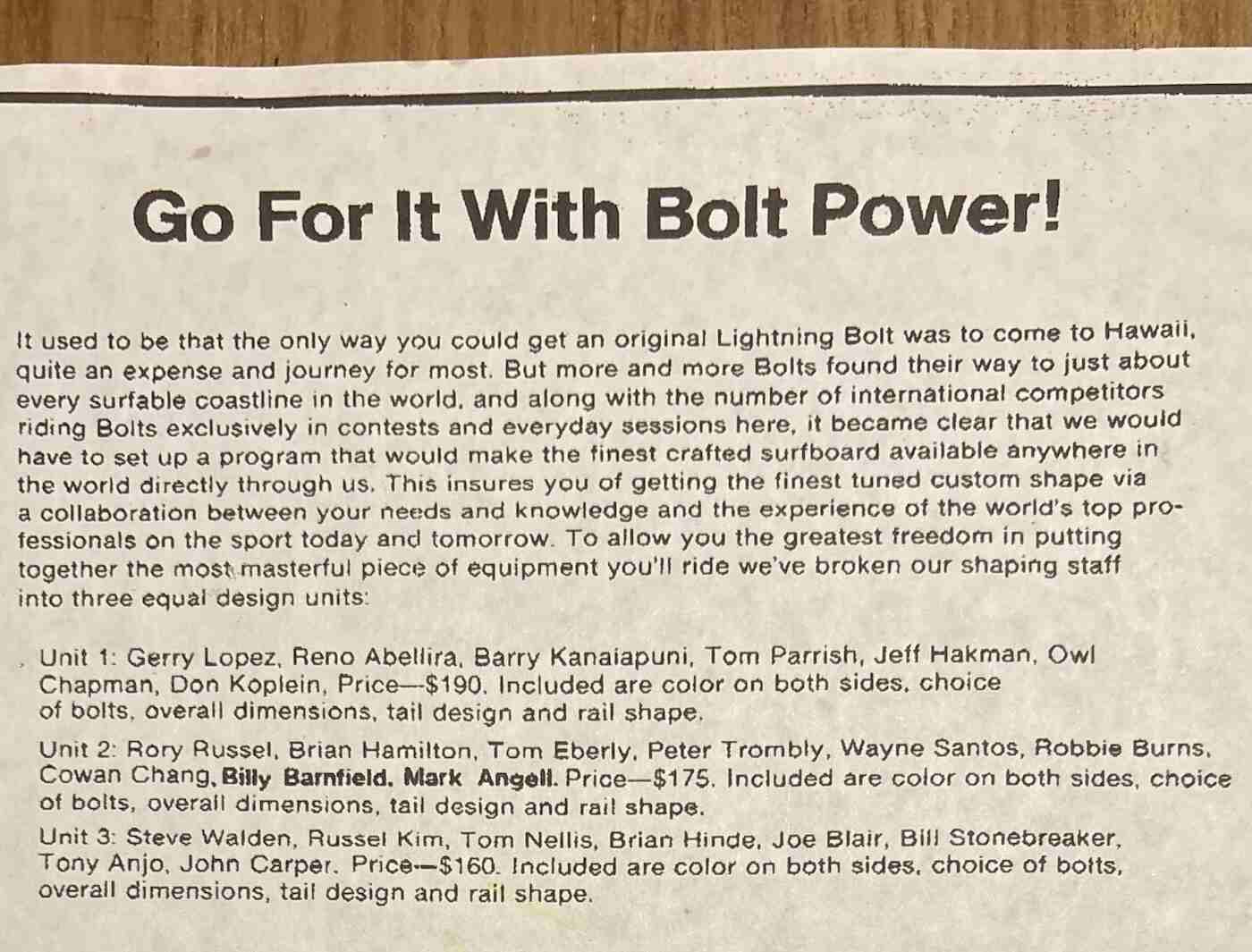
Rory Russell is named, sure, but the Bolt teamrider was a Unit 2 shaper who shared the right to represent Bolt in the shaping bay with about two-dozen others. One subject of Russell’s current slander, Pat Rawson, began shaping for Bolt just after the Unit 3 crew, from 1974 to 1977, when he worked directly for cofounder Jack Shipley. In fact, it didn’t take long for shaper-involvement to become a freestyle affair for any quality craftsman willing to slap a Lightning Bolt on their boards and sell them at the Kapiolani shop. Although, there were standouts such as Don Koplein who received praise from Bolt’s founders.
And that was just the beginning, because once Bolt caught on, licensing became a smart option for Lopez and Shipley to grow the brand internationally:
1975-76: Bolt Thrust into Spotlight by Magazines and Pro-Surfing
Lighting Bolt struck and set ablaze nearly every surf spot with a Cook Pine backdrop between 1970 and 1975. At the same time, its infectious aesthetic and functional superiority caught on across the U.S. mainland, Australia, and South Africa. But what really caused Lopez’ and Shipley’s creation to light up the universal sky was exposure in the magazines, with renowned surfing photographers Steve Wilkings, Art Brewer, and Jeff Divine to credit for coverage. This movement was followed by Randy Rarick and Fred Hemmings’ injection of professional contest surfing in 1976. It delivered elite surfers from all around the world to the North Shore of Oahu, where only a Bolt would do them justice at the Banzai Pipeline.
1978: Bolt Corporation Trademarks “Bolt Mark” with USPTO
Hoping to ride the wave of success of the Lighting Bolt label, investors got involved. Bolt Corporation was formed to manage licensing, and on the15th August, 1978, The United States Patent and Trademark Office (“USPTO”) registered a lightning bolt trademark (“Bolt Mark”) for clothing and surfboards with Bolt Corporation as the owner. While Lopez still had ownership in two Lightning Bolt shops in Hawaii, and held shares in Bolt Corporation, his patience with the business-end of things was wearing thin. By the time 1980 rolled around, Lopez was over it. There was only one thing that he wanted to do:
1985: Bolt Corporation Becomes Bolt International
Although Lopez left Bolt Corporation and handed the shop reigns to Shipley, he continued to shape Bolts. Continuing Unit 1 contributors on the roster during this time included Tom Parrish and Barry Kanaiapuni, while Unit 2 contributors included Rory Russell and Tom Eberly. A number of others joined the fold during the early 1980s. Then on February 25, 1985, the Bolt Corporation changed its name and assigned the rights related to the Bolt Mark to Bolt International.
1990-1996: Bolt Becomes International Licensing Corporation
Surfboards carrying the Lightning Bolt symbol continued to be produced through the period between 1985 and 1989 with little occurring on the corporate side. Then, on March 15. 1990, Bolt International became International Licensing Corporation (ILC, S.A.). The rights of the Bolt Mark passed to ILC in 1996. ILC holdings are affiliate companies of Ernst &Young and KPMG. Whatever soul was left in the Bolt name left the building.
2004: Bolt Mark Assigned to ILC Trademark Corporation
Nearly a decade passed after the 1996 ILC transition. Through it all a potpourri of personalities shaped Bolts. While the ILC maintained authority over apparel and accessories, little regulation was in place to manage who was allowed to layer a Bolt laminate between foam and fiberglass. Then, in 2004, the rights to the Bolt Mark were assigned to ILC Trademark Corporation, a British Virgin Islands-based holding company that owned and licensed intellectual property for various products.
2008: Lightning Bolt USA Relaunched
In 2008, ICL Trademark Corporation granted HTIL Corporation B.V. the exclusive right to manage ILC Trademark Corporation’s trademarks associated with the Lightning Bolt brand in the U.S. and Canada. HTIL then entered into an agreement with a Portuguese textile group TMG, granting TMG licensee rights to manufacture and sell Lightning Bolt licensed goods for the U.S. and Canada markets. Jonathan Paskowtiz, son of the one and only Dorian “Doc” Paskowitz acquired the U.S rights to Lightning Bolt hard goods (surfboards) and soft goods (clothing and accessories) in the U.S.. This was the first time saltwater reentered the veins of the Bolt brand since 1990.
2010-2012: TMG Goes After Aviator Nation for Using the Bolt
In 2006, Paige Mycoskie, launched Aviator Nation, a faux-vintage clothing and apparel brand that consistently sold (and continues to sell) overpriced hoodies and sweatpants to teenage girls, featuring a symbol identical to the one that Gerry Lopez doodled while on the phone pre-1970. She even dubbed them (and still does) as “Bolt” products. Mycoskie got away with it unchecked (but with a side-eye from the surf industry) for four years until 2010, when TMG notified HTIL of Aviator Nation’s use of the Bolt Mark. Two years passed with no further action taken, until 2012 when TMG sent Aviator Nation a cease-and-desist letter. The C&D did little to pause Mycoskie operations, as she pressed on with silkscreening the Bolt on her $189.00 tri-blends of polyester, cotton, and rayon.
2014: ILC Trademark Corporation Terminates TMG
Just as TMG USA petitioned ILC Trademark Corporation to do something about the dilution of the Bolt by Aviator Nation, ILC terminated their agreement with TMG USA on the 31st of December, 2014. That technically removed the rights to Bolt from TMG USA, which transferred the rights to the Paskowtiz family. However, TMG continued to manufacture Lightning Bolt-branded products pursuant to the rights it owns in Portugal, and imported the products into the United States (and presumably to the Paskowtiz family) for sale without authorization from ILC Trademark Corporation between 2015 to 2018.
2016-2019: ILC Trademark Corporation Finally Goes After Aviator Nation
Having previously ignored former licensee TMG’s pleas to ground Aviator Nation, ILC demanded that Aviator Nation stop using the Bolt Mark on clothing in 2016. Paige Mycoskie once again declined. In 2017, ILC Trademark Corporation filed a complaint against Aviator Nation and Ms. Mycoskie for trademark infringement and unfair competition. Backed by a $200 million empire, Mycoskie filed counterclaims against ILC and asserted various affirmative defenses, primarily focused on the argument that ILC had every opportunity to initiate a claim as early as January 2010 (when TMG notified HTIL of Aviator Nation’s use of its Bolt) but did not file its claim until October 2017. The case went to trial in 2019. Presiding judge, Michael W. Fitzgerald, concurred that the delay on ILC’s behalf was unjustified. He also bought the act that Mycoskie – who worked at ZJ Boarding House surf shop in Venice Beach until leaving to start Aviator Nation in 2006 – did not know of Lightning Bolt Surfboards. Fitzgerald filed in favor of Aviator Nation, and made a statement that made it quite clear that ol’ Fitz was no surfer:
“The value of a lightning bolt on certain clothing in a certain chain of stores is, in large part, divorced from whatever hazy and nostalgic associations still exist of 1970’s surf culture in Hawai’i.” (Michael W. Fitzgerald, United States District Judge)
2018-2019: ITOCHU and Yamato Become Co-owners of Bolt
Around the same time the U.S. economy came crumbling down, ITOCHU Corporation was given rights (by ILC in 2008) to manage and expand the Lightning Bolt brand in the Land of the Rising Sun. They primarily focused on men’s casual wear. A decade later, ITOCHU and Yamato International jointed forces to share ownership of the trademark rights to Bolt. The ITOCHU / Yamato International partnership was formed specifically to tap into the increased interest in action sports following the announcement that surfing and skateboarding would be included in the 2020 Tokyo Olympics. Surprisingly, neither have anything to do with the irreverent Snoopy’s Surf Shops that have popped up in Hawaii through recent years (credit that to Japan’s Bandai Co., Ltd.). Thus far, we’ve been spared seeing the Bolt on any member of the Peanuts gang, although Charlie Brown does rock a mean zig zag tee.
2019: Glorious Sun Gets Global Rights to Bolt?
Most people doing cursory research of who secured the global (not just Japanese) rights to Lightning Bolt will uncover the name “Gloria Sun” as a representative of a Chinese apparel company who somehow wiggled the trademark from ILC around 2019. They invariably hit a brick the size of the Great Wall of China from that point on. But SMH did some deeper digging, and found that this secretive Gloria Sun is very likely a misinterpretation of Glorious Sun Enterprises Limited. Glorious Sun is a Hong Kong-based fashion retail, trading, and investment group that has been involved in owning and operating surf-related brands, particularly through partnerships and joint ventures in the Greater China region. Prior to Authentic Brands Group (ABG) gobbling up former core surf brands such as Billabong and RVCA, Glorious Sun listed Quiksilver and Roxy (which are also now victims of ABG) as major brands within their portfolio. It doesn’t take a Terence Tao to do the math and realize that it was Glorious Sun Enterprises Ltd who quietly acquired the Lightning Bolt trademark around 2019.
2020: La Jolla Group Gets USA License to Lightning Bolt
The La Jolla Group, a company known for managing brands like O’Neill and Metal Mulisha, acquired the U.S. license to produce Lightning Bolt gear in the United States around 2020. There is speculation over whether they were given this license through a partnership with ITOCHU and Yamato International in the same manner that Jon Paskowtiz did through TMG Portugal, or if it was Glorious Sun to grant the permission. In either case, an overseas entity is the marionette to dangle the Lightning Bolt over the heads of American consumers through La Jolla Group (located in Irvine) to this very date.
But what about the shiny new Lightning Bolt surfboards that continue to be seen in a lineup near you? Keep reading.
2025: Rory Russell Goes Off the Rails
We return to 2025, when former Lightning Bolt teamrider and Unit 2 shaper, Rory Russell gets a bee in his bonnet over who deserves, as he sees it, to shape a Lightning Bolt surfboard. He takes great offense to the current Lightning Bolt USA website which lists Vitor Fernandes “Spottt”, Tom Eberly (also a Unit 2 shaper), and Craig Hollingsworth as approved shapers. Hollingsworth (the most successful in current sales volume) has the largest target on his back by the rambling man from Würzburg, Germany (Russell was an army brat). Although, Russell will sling red mud at anyone he deems fit from the jungles of Haleiwa where he rotates in and out of whatever shaping bay will have him. Feel free to peruse his Instagram feed for a look at what’s beginning to resemble Joe Biden’s final presidential debate.
Look, Rory Russell is a two-time Pipe Master, winning the prestigious Pipeline Masters surfing championship in 1976 and 1977. He also placed 3rd in 1974, and 2nd in both 1975 and 1978. There’s no taking that away from him. He has also produced some elegant collector-worthy Lightning Bolt surfboards through the years, even if the recent majority are alleged computer-aided design creations (as per the coconut wireless). What is troubling, is that Russell is tethering his supposed legacy (as a one of the great Lighting Bolt shapers?) to a label that has been passed around more than the collection plate at St. Peter’s Basilica. And if the timeline of Bolt’s passage from one corporate entity to another isn’t enough to make Russell’s campaign naive at best, let’s recall Jack Shipley’s requirement as to who was allowed to apply the label to a quality board when they opened their Kapiolani store:
“Well, put a Lightning Bolt on it and we’ll sell ’em here in the shop.” (Jack Shipley)
So who owns Lightning Bolt Surfboards? History does, with a firm end date of 1980 when Lopez walked into a boardroom to tell everyone that he just wants to go surfing.