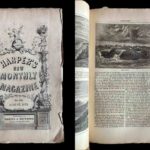
Harper’s Magazine No. 279 August 1873 Featuring Hawaiian Surfboard Riding
- 28 March 2026
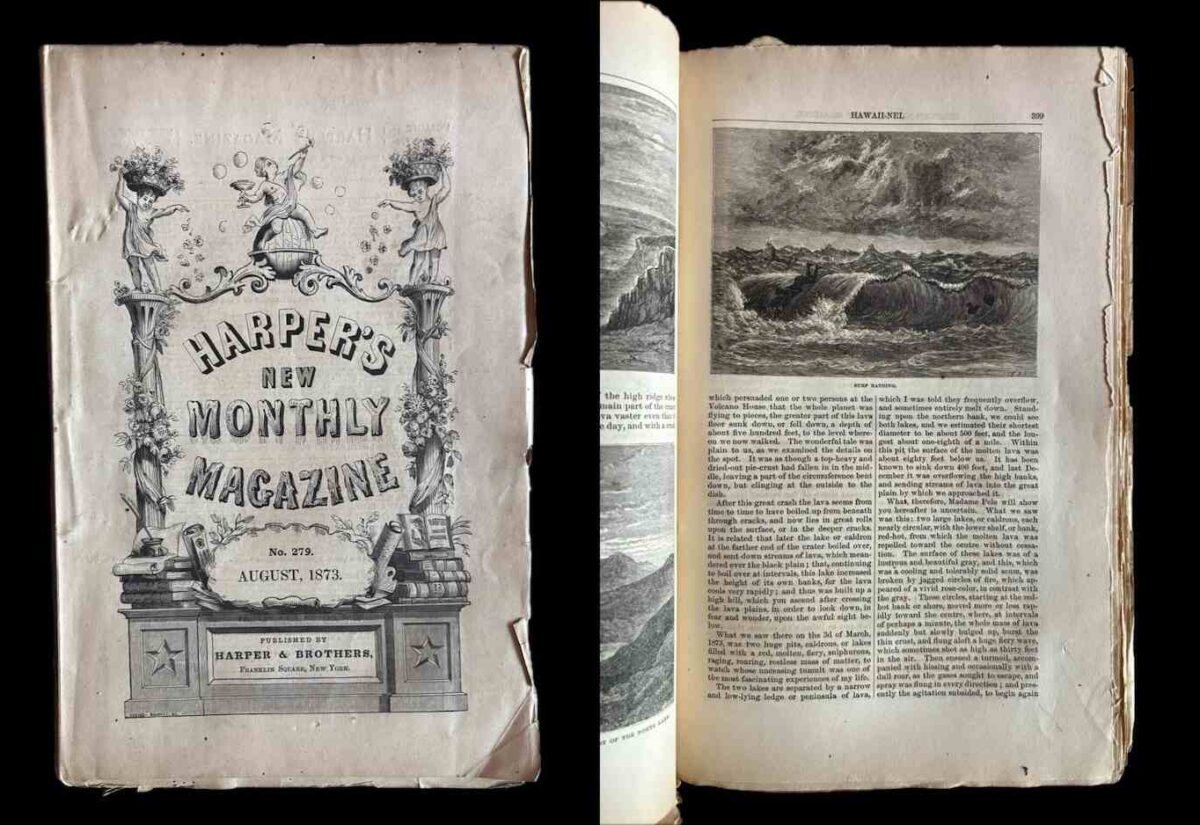
One of our curation missions at Surf Museum Hawaii (SMH) is to hunt down every magazine to feature surfing on the cover and within its pages between the mid-to-late 1800s and the early-to-mid 1900s, before it became commonplace. The earliest reported magazine to do so, was Frank Leslie’s Illustrated Newspaper (a magazine, really) when it featured a sketch titled “Surf Swimming at Hawaii, Sandwich Islands” in their April 7, 1866, edition. The next of note, was Harper’s New Monthly Magazine. Founded 1850, Harper’s is the oldest continuously published monthly magazine in the United States. In their August 1873 (No.279) issue Harper’s ran a multiple page feature on the Hawaiian Islands. On pg.399 is an image titled “Surf Bathing”, transferred from woodblock credited to a Lieutenant–Commander William Bainbridge Hoff of the flagship California, which made two trips to Hawaii in 1871-1872 and again in 1872-1873. For the uninitiated, woodblock printing is a technique where an image is carved into a wooden block, inked, and pressed onto paper or fabric. A drawing is transferred to wood, carved away, and the raised, un-carved surface is inked for printing in newspapers and magazines, et cetera. Hoff apparently observed Hawaiians in the surf at Hilo, Hawaii, in what looks to be a challenging onshore day in the 3-5 foot range:
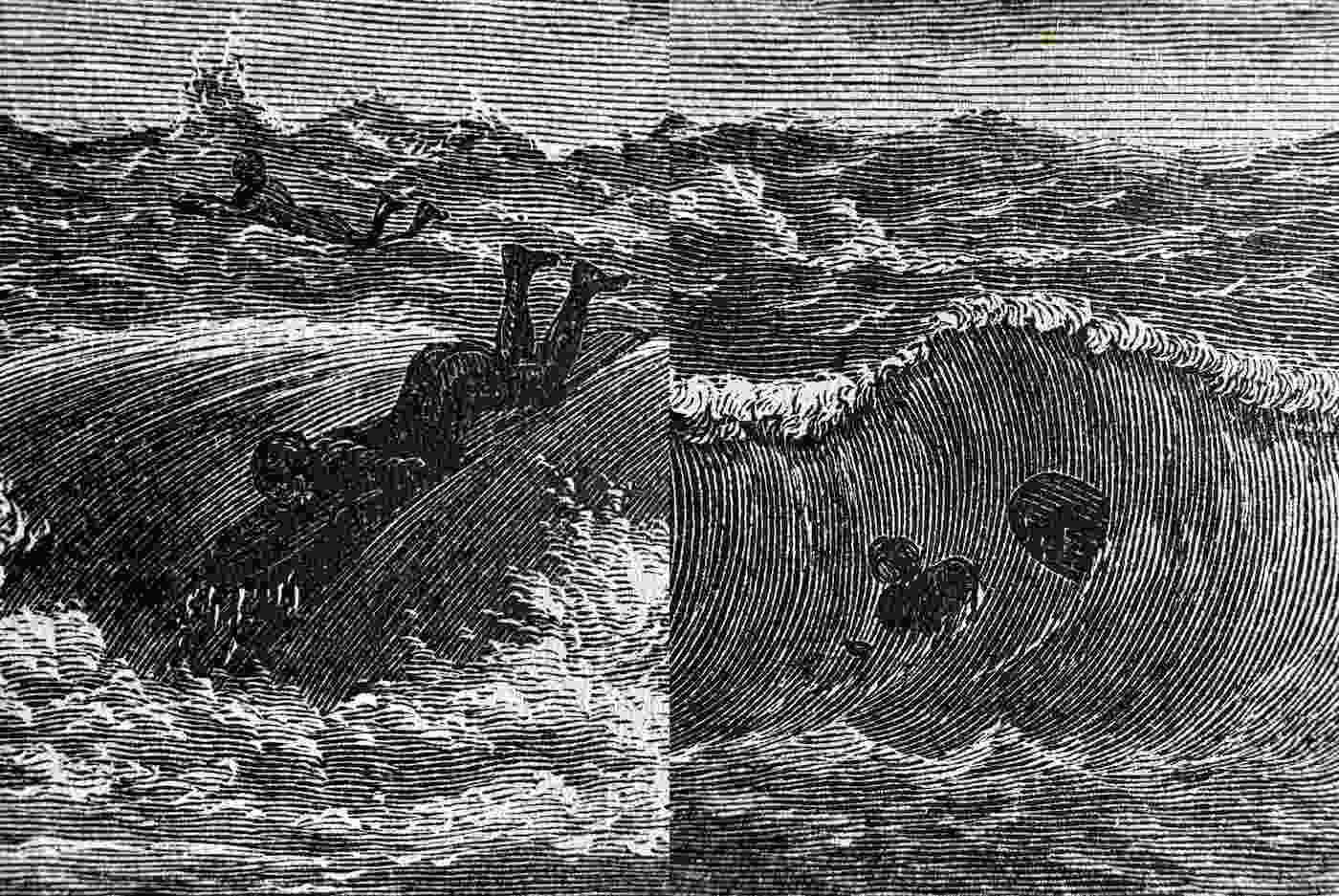
The accompanying writeup went as follows:
“Finally, Hilo is one of the very few places on these islands where you can see a truly royal sport – the surf-board. It requires a rough day and a heavy surf, but with a good day, it is one of the finest sights in the world. The surf-board is a tough plank about two feet wide and from six to twenty feet long, usually made of the bread-fruit-tree. Armed with these, a party of tall, muscular natives swim out to the first line of breakers, and, watching their chance to duck under this, make their way finally, by the help of the under-tow, into the smooth water far off beyond all the surf. Here they bob up and down on the swell like so many ducks, watching their opportunity. What they seek is a very bigh swell, before which they place themselves, lying or kneeling on the surf-board. The great wave dashes onward, but as its bottom strikes the ground, the top, unretarded in its speed and force, breaks into a huge comber, and directly before this the surf-board swimmer is propelled with a speed which we timed and found to exceed forty miles per hour. In fact, he goes like lightning, always just ahead of the breaker, and apparently down hill, propelled by the vehement impulse of the roaring wave behind him, yet seeming to have a speed and motion of his own.
It is a very surprising sight to see three or four men thus dashed for nearly a mile toward the shore at the speed of an express train, every moment about to be overwhelmed by a roaring breaker, whose white crest was reared high above and just behind them, but always escaping this ingulfment, and propelled before it. They look, kneeling or lying on their long surf-boards, more like some curious and swift-swimming fish—like dolphins racing, as it seemed to me—than like men. Once in a while, by some mischance the cause of which I could not understand, the swimmer was overwhelmed; the great comber overtook him; he was flung over and over like a piece of wreck, but instantly dived, and reappeared beyond and outside of the wave, ready to take advantage of the next. A successful shot launched them quite high and dry on the beach far beyond where we stood to watch. Occasionally a man would stand erect upon his surf-board, balancing himself in the boiling water without apparent difficulty.
The surf-board play is one of the ancient sports of Hawaii. I am told that few of the younger generation are capable of it, and that it is thought to require great nerve and coolness even among these admirable swimmers, and to be not without danger. For the sketch of it which accompanies this article, as well as one of Kilauea, I am indebted to the skillful pencil of Lieutenant-Commander William Bainbridge Hoff, of the flag-ship California.”
Aside from the one that is now in the SMH collection, few, if any, complete copies of this August 1873 issue of Harper’s New Monthly Magazine exist. Although, a framed cut-out from the magazine of the image depicted in the woodblock printing was made available at the Spring 2026 California Gold Surf Auction as a part of the Historic Engravings of Early Surfing lot (view here).
SMH Appraisal Value: $100 USD