“Eddie wasn’t the only guy who would go.”
Big wave surfing is as full of tales as tall as the breakers many have purported to ride. Surfers have a knack for making mountains out of molehills more than anyone, with oral histories obscuring the truth in order to to keep cultural appropriation at bay, Waimea’s included. With each historical wave there a cast of characters from the late 1950s into the 60s that we’re all accustomed to hearing about; including Downing, Froiseth, Noll, Trent, and Aikau. You know, the usual suspects. But one name that rarely ever pops up yet deserves inclusion on the Mt. Rushmore of big wave riders in Hawaii is of Italian origin – Galanto.
How the Encyclopedia of Surfing (EOS) among other comprehensive anthologies of surfing lore have neglected to even mention Charlie Galanto is a head-scratching mystery. The only author to pay the Italian his due was surf historian Mark Fragale (and friend of SMH) in the article “On the Wind,” published in Volume 21, Issue 5 of The Surfer’s Journal. In his tribute, Fragale honors one of Hawaii’s quietly influential surfing pioneers by tracing his remarkable journey from a young Marine stationed at Kaneohe Marine Corps Air Station to a respected big-wave surfer on Oahu’s North Shore. The author details how after discovering surfing during his military service, Galanto’s natural talent quickly earned him recognition for charging powerful waves at breaks such as Waimea Bay and Sunset Beach, while his courage was tested in a near-fatal wipeout at Ala Moana Bowls that became one of the defining moments of his life. Beyond his accomplishments in the water, Fragale made it clear that Galanto helped shape Oahu’s surfing community by opening the Greg Noll Surf Center, giving surfers a place to gather and helping expand the culture and sport during a transformative era. The historian’s article ultimately celebrates not only Galanto’s surfing achievements but also his humility, resilience, and lifelong connection to the ocean, portraying him as a respected waterman whose legacy continues to inspire long after he stepped away from the spotlight – a spotlight that he generally avoided to begin with. View Fragale’s 2011 article right here.
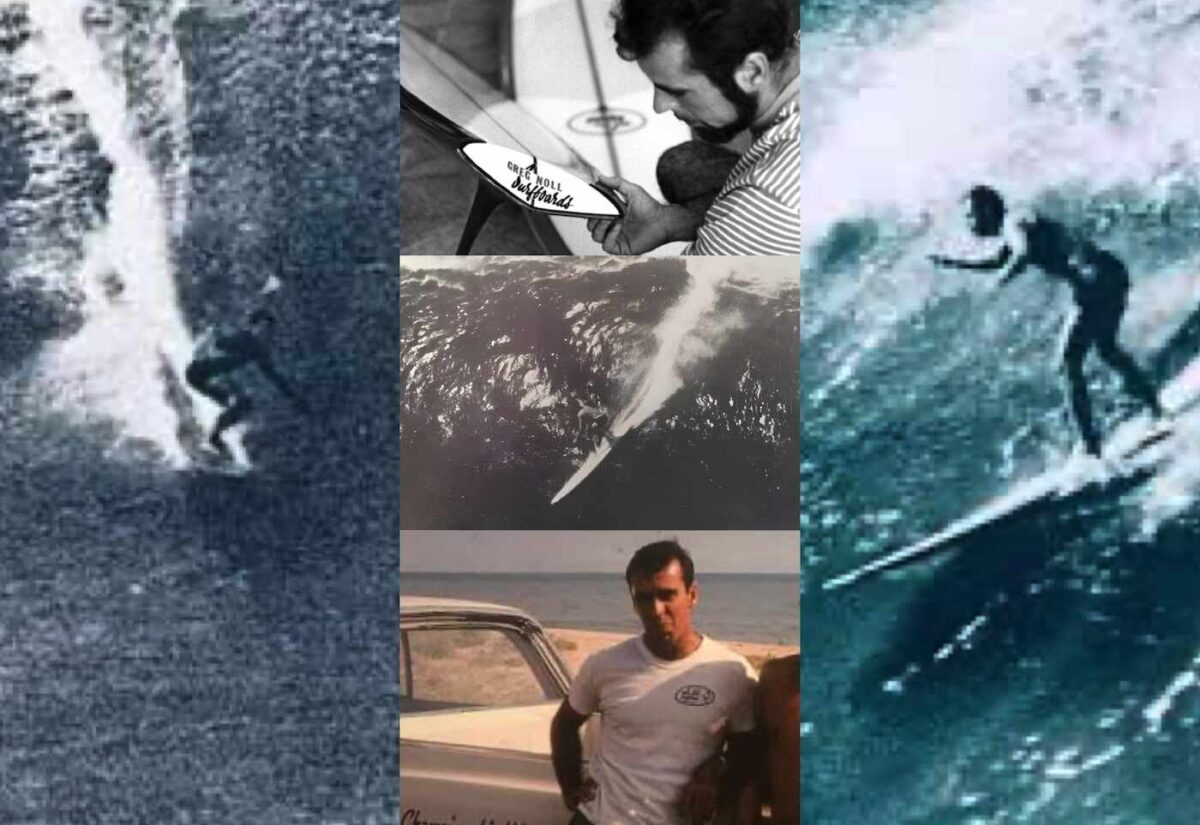
We honestly can’t fault other publishers for neglecting to hold Galanto in the same regard as those most synonymous with behemoth wave riding. As editor’s we’re trained to hold tight to facts like the last plank of a broken lifeboat that is the fading memory of 1950s-60s surf culture. No big contests wins, no Big Wednesday moments, and very few photos. Instead, Charlie surfed. And yes, he built world class boards, but didn’t bother to embed his name in big bold letters on rice paper laminate, preferring to let his work do the talking under the Greg Noll Surf Center brand. Even his contribution to the development of one of the first functional short boards of the Shortboard Revolution is overshadowed by those made by Bob McTavish, Dick Brewer, George Greenough, and Nat Young.
Galanto’s tale is not unique, mind you. Though Thomas Edison is widely regarded as the inventor of incandescent light bulb, his early carbon-filament bulbs burned out quickly. Lewis Howard Latimer, Edison’s draftsman and engineer, invented the method of producing durable carbon filaments that made commercial electric lighting viable. Beyond the filament, Latimer drafted the drawings for Edison’s incandescent light bulb patent and provided critical expert testimony that helped defend the patent from competitors. Yet Latimer’s name rarely appears alongside Edison’s in popular history. The same pattern repeats itself across countless fields—including surfing. Big-wave riding and surfboard design were never the work of a single hero, but the product of a community of craftsmen, experimenters, and watermen whose ideas built upon one another. While a handful of legendary names came to define the sport in the public imagination, others made equally important contributions without the spotlight. Like Latimer, Galanto was a pioneer who helped shape history, even if history remembers others.
Fortunately, we live in a different era, where under a glow made possible of a Lewis Howard Latimer invention, an author (yours truly) can type another chapter into the narrative of big wave riding and request that readers share the good word with their digital masses. The perspective suggests that, yes, Charlie Galanto had been upstaged by those who enjoyed seeing their names in the spotlight, but this may have been due not only to humility, but also to a ravenous drive to set his sights so high that ambition eclipsed accomplishment. The two traits may seem to contrast, but in Galanto’s case they align like a west-northwest swell with light offshore southern winds at one of his favorite breaks.
Below is an examination of pivotal moments that align with this thesis.
Defining Moments That Suggest Charlie Galanto’s Distance from the Spotlight May Have Left a Greater Destiny Unfulfilled
In the Shadows of Da’ Bull
On a massive day at Third Reef Pipeline in November 1964, Greg Noll, Mike Stang, Ricky Grigg, and Charlie Galanto paddled into what was then completely uncharted territory, venturing farther offshore than anyone had dared before. Each man faced the same heaving mountains of water, but their approaches couldn’t have been more different. Galanto, true to form, repeatedly positioned himself for some of the day’s most critical and unforgiving waves, taking the greatest risks with little concern for who might be watching. Noll, meanwhile, understood that history also belonged to spectacle. Clad in his now-iconic black-and-white prison-stripe trunks, he patiently waited as the last man in the lineup, biding his time for what promised to be the wave of the day. In a twist of surfing folklore, he never completed that ride—ultimately wiping out after an unforgettable drop—but the image, the commitment, and the sheer audacity of the attempt cemented his place in history. Galanto’s fearless contributions, by contrast, became just another example of how surfing often remembers the performance while overlooking those whose greatest achievements unfolded beyond the spotlight.
Galanto discusses the Third Reef Pipeline experience in a recent interview with Surf Museum Hawaii (SMH):
Missing the Point
During the period when the outer limits of big-wave surfing were still being mapped by instinct rather than forecasts, Kaʻena Point existed more as whispered mythology than a realistic objective. To most of the era’s premier watermen, the wave represented equal parts fantasy and fatalism—a pipe dream for the bold and a nightmare for everyone else. Unlike Waimea Bay, whose moods could at least be anticipated, Kaʻena demanded an almost implausible convergence of conditions before revealing itself. A giant northwest swell had to arrive from precisely the right direction, accompanied by favorable winds, manageable tides, and enough visibility to locate a breaking reef hidden beneath miles of turbulent ocean. Miss any one of those ingredients, and the wave simply ceased to exist. Yet while others regarded Kaʻena as an impossible curiosity, Charlie Galanto became the first to speak openly about making it a legitimate objective, treating the island’s northernmost giant not as an untouchable legend but as the next logical frontier.
Galanto possessed an unusual combination of attributes that made such ambition seem almost credible. At Waimea Bay, his performances rivaled those of Eddie Aikau and other celebrated chargers, earning quiet respect from those who understood that courage in heavy water was measured by commitment rather than publicity. He self-described as someone driven by an addiction to adrenaline, forever searching for a wave that would redefine his own limits for his own sake, not for coverage on ABC’s Wide World of Sports. By that measure, Kaʻena Point was the inevitable destination. Ironically, the greatest obstacle was never fear but timing. The wave’s rare alignment of swell, wind, tide, and access occurred only on the ocean’s own unpredictable schedule, while Galanto’s life increasingly revolved around injury recovery and responsibilities of pushing forward surfboard design. The result was a frustrating paradox: the man perhaps best suited to challenge Kaʻena Point found himself waiting for a moment when both nature and circumstance would cooperate—a moment so elusive that the dream remained forever just beyond the horizon.
Kaʻena Point would remain unconquered for another twenty years after Greg Noll, Mike Stang, Ricky Grigg, and Charlie Galanto pushed the limits at Third Reef Pipeline. It wasn’t until the winter of 1984 that legendary big-wave rider Alec “Ace Cool” Cooke finally transformed decades of speculation into reality. Taking advantage of a massive northwest swell, Cooke reached the isolated break by helicopter before committing himself to one of Hawaiʻi’s most elusive waves. The achievement underscored just how far ahead of its time Galanto’s ambition had been. What had once seemed like an impossible fantasy in the 1960s ultimately required not only extraordinary courage, but advances in logistics and access that earlier generations simply did not possess.
The Speargun That Never Took it’s Shot
“What one does is what counts. Not what one had the intention of doing.” — Pablo Picasso, 1923
It’s hard to argue with Picasso, but in this writer’s opinion, Galanto’s intentions certainly counted for something substantial, both in his intention to surf Kaena Point, and in creating a work of functional art: the first surfboard designed specifically for surfing a 100-foot wave. The concept board was the culmination of collaborative conversations with Craig Sugihara. As a young laminator at Greg Noll Surfboards in Hawaiʻi, Sugihara honed his skills under Galanto’s guidance, learning the meticulous craftsmanship and innovation that defined the shop. Their mentor-apprentice relationship extended beyond routine board building, fostering a shared curiosity about the future of surfboard design and the challenges posed by ever-larger waves. That spirit of their discussions led Galanto to develop the concept for the Speargun—a purpose-built big-wave surfboard envisioned for riding waves on a scale that most surfers of the era considered impossible. The resulting carbon-fiber “Speargun” is the stuff of legend. During a visit between SMH, Randy Rarick, and Charlie Galanto, the two trailblazers discussed the vessel in fascinating detail:
There is no shortage of comments accompanying the clip questioning why the Speargun was never ridden, with armchair quarterbacks thumbing their iPhone screens and insisting the board should be released so it can fulfill its destiny. If Galanto had shared the limelight ambitions of the McNamaras, it may very well have been taken down from the wall of his floating boudoir and featured in HBO’s next season of 100 Foot Wave. But he’s not one of them. Charlie never had sponsor obligations to fulfill, nor anything to prove to anyone but himself. It was the chase alone that kept him ticking, and at 85 years old, his eyes carry a palpable sense of contentment that we should all hope to possess should we reach the same milestone.
Today, Charlie Galanto lives an existence that few, if any, prominent figures from our culture’s history enjoy. He and his renowned physician wife, Jutta Madjar-Galanto, spend their later years aboard a custom-built floating home that reflects Charlie’s lifelong connection to the ocean. The large impressive vessel embodies Galanto’s resourceful, independent nature—part surf legacy, part maritime craftsmanship, and part personal retreat—allowing him to continue a life on the sea long after his days charging Hawaii’s biggest waves and reshaping the course of surfboard design history. A destiny unfulfilled? Maybe not so much.
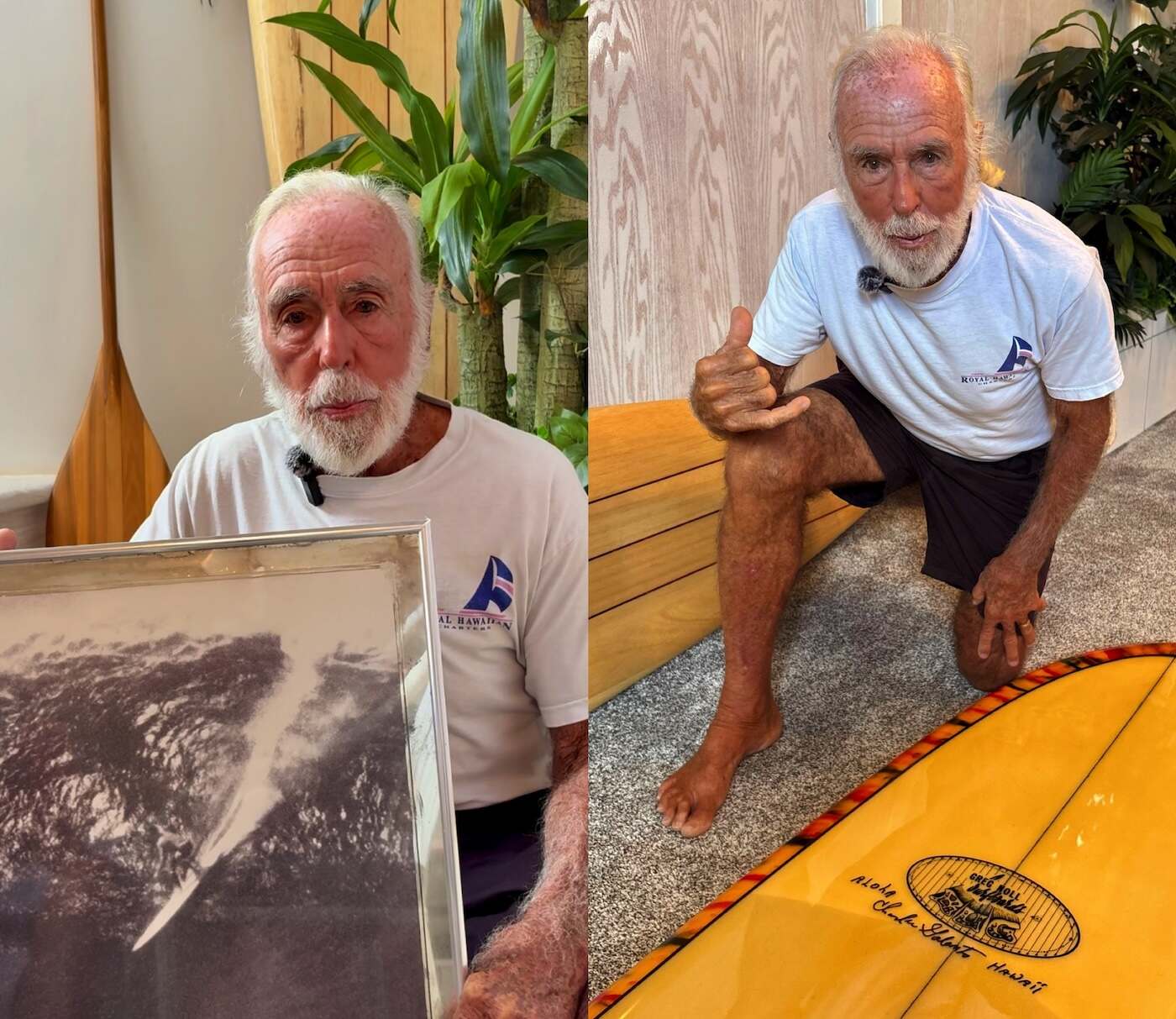
Charlie Galanto, May 2026 (copyright protected by SMH)