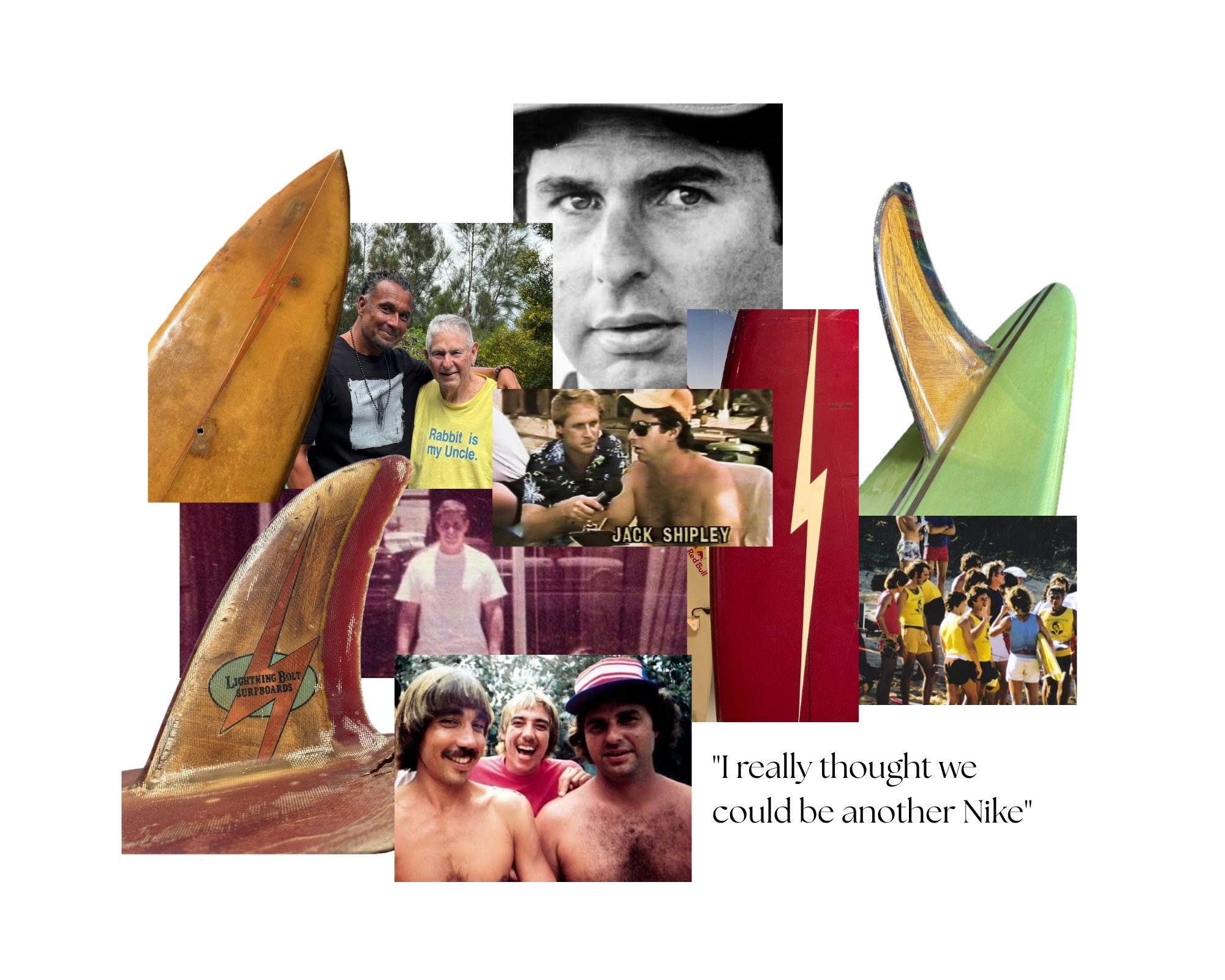
We just completed a vertical climb to Upper Mānoa (upper being an understatement) on the kind of road you wouldn’t trust anything less than four cylinders to handle. Thankfully, the island-standard rental—a Ford Bronco that former Team Bolt rider Andy Hur had secured—made the trek just fine. Hur also managed to get us a meeting with the elusive Jack Shipley, co-founder, alongside Gerry Lopez, of Lightning Bolt Surfboards.
Impressive, I thought, as I exited the Bronco and spied the large A-frame house that capped the affluent residential community. I find it heartwarming when anyone from this culture of ours makes it out alive and thriving on the financial end of things. But I also noticed a stack of Amazon boxes at the door, an indicator that no one was home. Andy called Jack on speakerphone to inquire if we had the right address. The voice on the other end told us to walk to the right of the A-frame and follow the sunburnt lawn to what some here in the Hawaiian Islands might describe as an ʻohana bungalow. Others might call it a shack.
When we entered, a figure framed by the Koʻolau mountain ridgeline in a bright yellow T-shirt reading “Rabbit Is My Uncle” appeared from the back deck of the shanty, his attire clearly chosen to test my worth as a budding surfing historian. “Love the shirt,” I said as I extended my hand, confirming that I certainly knew it was in reference to Rabbit Kekai. Jack’s handshake was firm, with strength built up from gripping the aluminum walker that the 74-year-old icon now needed to navigate his home.
We nestled around the kitchen (slash dining room slash living room) table amidst a visual cacophony of pots, pans, old photographs, and a disproportionate number of novelty signs with clever quotes. A chalkboard on the front door indicated a love of pizza. I was certain that somewhere there was a Garfield poster exclaiming his distaste for Mondays.
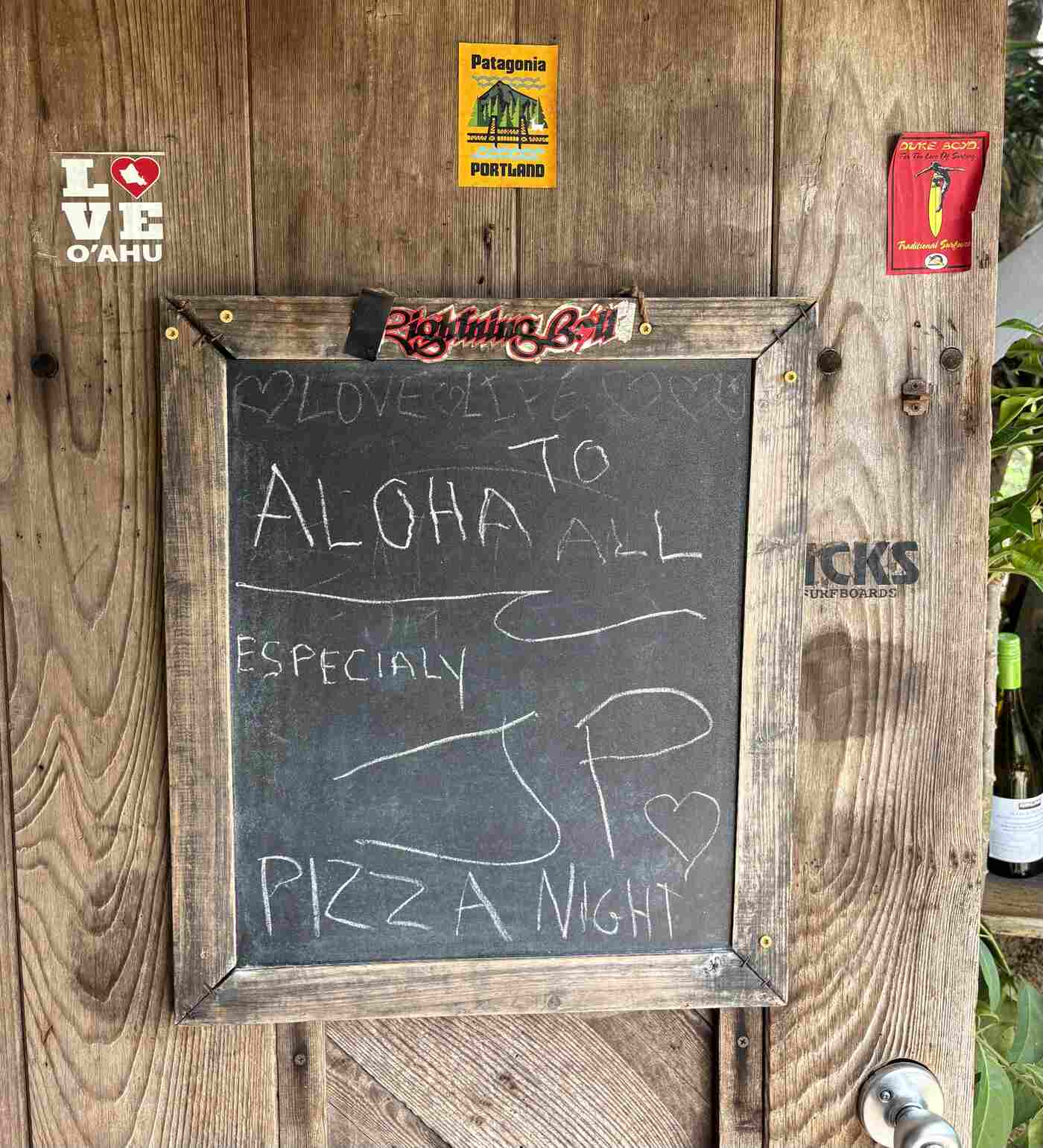
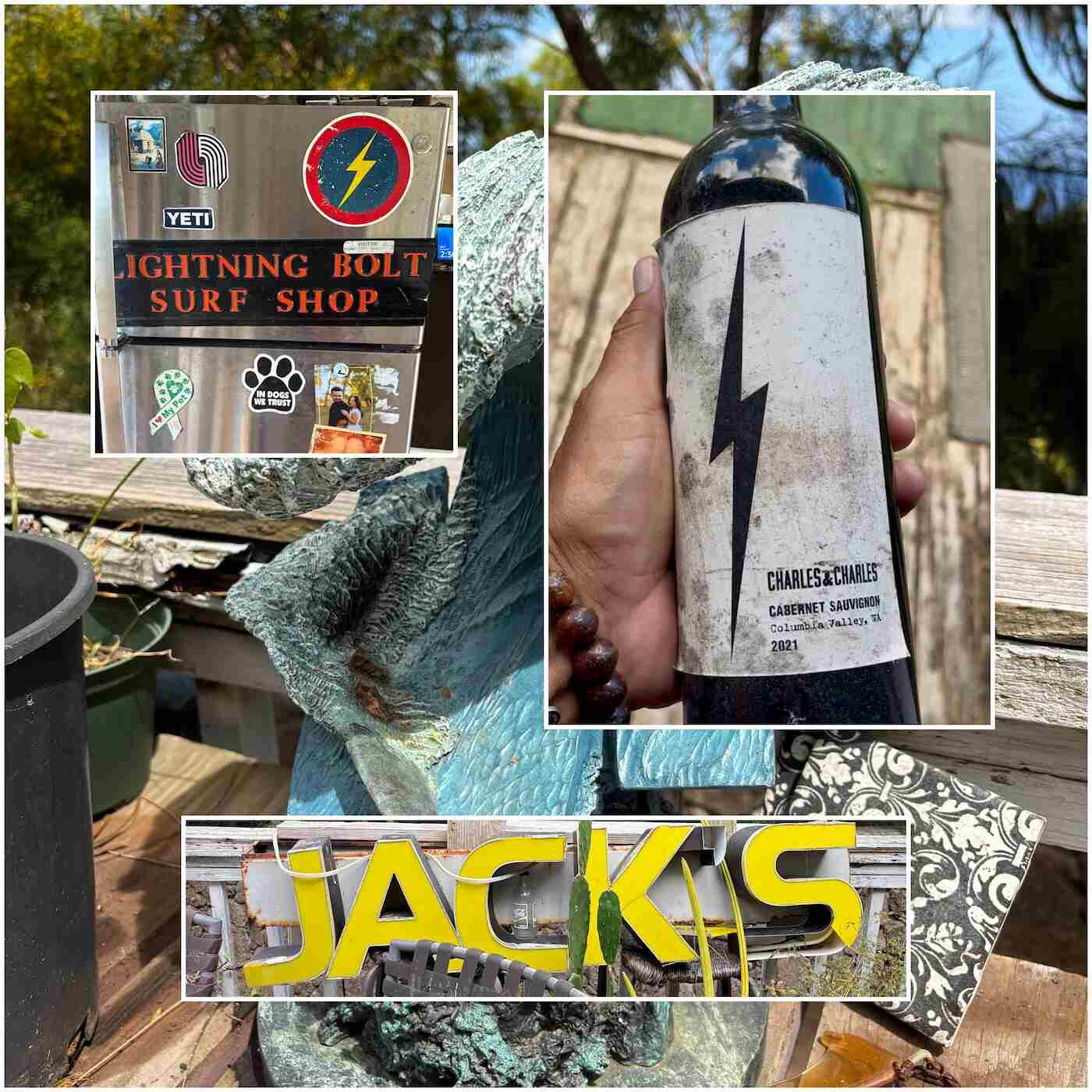
But I also noticed contest trophies, memorabilia, Triple Crown of Surfing posters, and various items emblazoned with lightning bolts, including a bottle of Cabernet Sauvignon gifted to Shipley by a Columbia Valley, WA, winery that clearly had some salt in the room when designing labels. A large JACK’S Surfboards store sign cheekily rests against a fence, reminding the Abdelmuti and Abdelfattah families who the real Jack of the surfing trade is.
I wondered what had taken me so long to notice the surfboards strewn about the humble quarters. I suppose I had anticipated them being mounted on the walls and lined up in the rafters of the A-frame I had initially envisioned as Shipley’s place of residence.
But once I got over my expectations, the magic of it all began to unfold.
Jack spoke to me with a familiarity and invitation akin to those who have known each other for years: “Marcus, wait until you see what’s in my bedroom. Go check it out.” I took the bait and walked across the wooden plank of the outdoor deck that bridged the kitchen (slash dining room slash living room) and the slumber where Jack lays his head each night.
On the mattress was an impossibly mint-condition, one-of-a-kind Phil Edwards Honolulu balsa surfboard, lying there like a temptress, daring my caress. I plucked it up from its widest curvature and brought it out into the sunlight to Jack’s great pleasure. His prized possession hit its mark. With eyes wide, I instantly tried to explain its monetary value, throwing out numbers like $15K to $20K at auction. He concurred with my appraisal but also stated that it would most certainly be buried with him, which may or may not have provided some insight into why a 401(k) was never part of the plan he and Lopez had when they started Lightning Bolt Surfboards in 1970. I also found it interesting that his most prized board was not a Bolt, and that there were none among the visible quiver in his home.
The table was set for a tale that has become unfortunately common among surf brands over the last six decades: ambitious good intentions followed by the injection of licensing agreements and lawyers, surfboards being traded for Boards of Directors, and soul being traded for sold-out, et cetera. It has all become far too familiar, with Lightning Bolt Surfboards’ journey being the first in a long and lingering line of surf brands losing their way.
When the label launched in Hawaii in 1970, it is difficult to imagine a purer intention than what materialized from the minds of Gerry Lopez and Jack Shipley. The brand emerged at the collision point of the counterculture movement, anti-establishment ideals, and the psychedelic era, when surfing itself was undergoing a revolution. The old guard’s heavy longboards were giving way to shorter, lighter, more responsive boards designed to fit into the increasingly critical parts of the wave. Lightning Bolt embodied that change. Lopez’s mastery of Pipeline and the shortboard’s ability to disappear deep inside a barrel gave the brand an unmistakably progressive edge—a surfboard built not for convention, but for pushing beyond it.
The aesthetic spoke the same language. That clean, unmistakable lightning bolt airbrushed down the deck was simple, bold, and instantly recognizable, yet perfectly at home in an era defined by psychedelic art, experimental music, rebellious fashion, and youth culture in full revolt. Beyond the lineup at Oahu’s most dangerous waves, the world was wrestling with the upheaval of the civil rights movement, the Vietnam War, and increasingly vocal anti-establishment sentiment. Surfing offered its own kind of escape from that turmoil: physical, spiritual, elemental, and far removed from the machinery of the mainland. Lightning Bolt did not need to manufacture that feeling. It was already there—in the waves, in the boards, in the people riding them, and in the generation that recognized itself in the bolt. The brand wasn’t simply selling surfboards; it became a symbol of a radical shift in how surfing—and the life surrounding it—could be imagined.
But of course, the dream was short lived.
While Gerry Lopez provided his account of the brand’s lifecycle in a previous Surf Museum Hawaii (SMH) interview, which can be referenced in this article, Who Really Owns Lightning Bolt Surfboards, it’s only fair to get his cofounder’s side of the story. Shipley honored yours truly with unfiltered answers to questions about Lightning Bolt and also weighed in on his time as professional surfing’s head judge, along with his opinion on what has become of the sport, today.
Part I: On the Life and Death of Lightning Bolt
How the Lightning Bolt Brand Came to Be
MM: I asked Gerry this question, and I’ve heard a few variations from others who were around the two of you when the label was formed, but let me ask you: How did you and Gerry come up with the Lightning Bolt brand and symbol?
JS: The polite version is that there was a particular blank that Gerry shaped that ended up being the original Pipeliners. And this particular blank (and shape) was not particularly suited for anywhere else. It was only suited for Pipeline. So he called it a Lightning Bolt. That’s the nice clean version.
MM: Is there another version?
JS: Uh yes, in those days we certainly enjoyed our marijuana and legend has it that a super special joint that we had was sort of converted into our image, which was the Lightning Bolt. And it was it was kind of neat in the beginning because I would answer the phone and say “Lightning Bolt Surfboards” and people would go what what are you talking about? Where did I call? So that was the original Lightning Bolt – it was a it was a big fat joint that we used to have and a special variety. Gerry Lopez was a special variety and the stuff that he made and believed in was really special.
MM: What made the label take off so quickly from the moment it launched in the early 1970s?
JS: Gerry. He was so young when he worked as Surf Line, and he had this image. I don’t know if he perceived that he would ever be great like he became, but he had a strong image of what he wanted to be like, and the kind of person he wanted to be, and what he wanted to represent him. And that’s really what the Lightning Bolt fever and Lighting Bolt success was all about. It happened with one guy.
Who Qualified to Shape for Lightning Bolt Surfboards
MM: There’s been a lot of conversation and, some may say, controversy—namely coming from one individual, Rory Russell—of late about who had, and has, the so-called right to shape for Lightning Bolt. Gerry set the record straight, naming you as the one who dictated who could represent Lightning Bolt, and that it was a pretty wide-open field. True?
JS: The thing that we made was that if you made boards for Lightning Bolt, they always had a Lightning Bolt on them. So, we did not have to own shapers or manufacturers. We didn’t have to own them. But if they wanted to make boards for the shop, they had to have a Lightning Bolt.
I don’t know if you ever heard of Kenny Tilton, but he was a really good shaper. Got started in the ’50s, and he wanted to put his boards in the shop, but he didn’t want to put a Lightning Bolt on them. And I told him, “Hey, Kenny, that’s the only thing that we ask: that the boards that are made for the shop, to be sold in the shop, they all have Bolts on them.” He really wasn’t sold on that, but he said, “Well, you know, I’ve got all these team boards and I need to get rid of them.” I said, “Well, we do a consignment thing.” And so, he left me with six boards of his team’s work, and he was not well financed himself. So, he needed to recycle these things. So, I told him, “Man, it’ll probably take 10 days to sell these boards.” Well, I sold all six of them in three days. And I called Kenny up and just said, “Kenny, I’ve got some money for you.” He said, “Well, I really need some money.” And I said, “I sold all the boards. And after that, they made some Lightning Bolts. (Laughs.)
MM: So there was no strict Unit One, Unit Two, and so on? I’ve seen the paperwork on those things, but basically any quality worker could come into the shop and put a Bolt on his own board?
JS: Yes.
What Caused the Death of Lightning Bolt Surfboards
MM: I spoke to Gerry about this as well, but what is your take on when things became too “corporate” and began to fall apart?
JS: You know, they just…we did this thing that was perfect and was so pure and clean. And then these corporate guys that we trusted to develop Lightning Bolt into a major brand—you know, they didn’t have a clue of who we were, what we did, and what our goals were. They didn’t listen to us. They just, you know, plowed ahead and failed. And they decided that somewhere along the line, the best thing that they could do was have attorneys fight. So the attorneys fought for the people that made the Lightning Bolt clothing, and they fought against the other side, so to speak, and everybody lost. The attorneys got rich. They each made a quarter of a million dollars. And that was the end of the company.
MM: So when Gerry sold his shares, they didn’t go to you; they went to the corporation?
JS: Yes.
MM: So, how did you feel when Gerry sold? Did he talk to you about it ahead of time?
JS: You know, Gerry had such strong beliefs in his own particular system, and I was influenced by the outside system, so to speak, in the development of the brand because I really thought we could be another Nike, you know. And Gerry thought so too, but he thought so on his level, not on this imaginary level that these people created, with licenses all over the place and nobody knew each other, nobody cared about each other. They were just doing it for their money, period. And that’s how they got involved, and it was just wrong.
MM: How long did you stick around for after Gerry left?
JS: About three years. And I tried to get them to set the apple cart straight, but, you know, the thing is, Marcus, if they wouldn’t listen to Gerry, for sure they’re not going to listen to me. So whatever I tried to tell them in terms of being real about Lightning Bolt went in one ear and out the other. They just never paid attention.
MM: Do you think there was another heyday between that time, and has there been a resurgence, a comeback? Do you like what the company is doing now, or has it completely lost its soul?
JS: It’s lost all its soul. No bueno.
MM: So what happened in 1983, after you sold your shares?
JS: The (Lightning Bolt) shop lasted until 1985, but it was starting to suffer. It wasn’t well managed by me, at all, I had kind of lost interest in it, because I was really focused on setting the Lighting Bolt team in a good focus like it was originally, which was distracting from the shop. And so the shop fell apart. People started doing different things, different logos came up, different approaches came up. Similar to what we had but different. It lasted a couple of years after that, Marcus, but with that, it was done. The shop closed in 1985.
Part II: On Life After the Death of Lightning Bolt
After the shop closed its doors in 1985, Jack Shipley attempted a solo startup in the same vein as Lightning Bolt—North Shore Water Sport Inc.—but was unable to find financial backing. He started a freelance landscaping business for a period but soon found a proper home in professional surfing as a head judge, beginning with Fred Hemmings’ and Randy Rarick’s International Professional Surfing (IPS) and continuing on to the Association of Surfing Professionals (ASP), while also holding head judge status through the Triple Crown of Surfing until Rarick handed the reins to Jodi Wilmott, the GM of the newly structured World Surf League (WSL) Hawaii team. Shipley reflects on that period fondly, noting that it helped sweeten the bitter taste left by failure of Lighting Bolt.
MM: How the experience as the head judge for professional surfing? Today, for the WSL, everyone is so critical of the judges and the judging process. Was it like that back then? How did the experience impact you personally?
JS: We had some real strong surfers that weren’t always that happy with the results. But in general, in the 40 years that I participated in that thing, I had a pretty smooth ride. And I think people believed in me like I wanted them to believe in me—that I was doing my absolute best to deliver the first-class results that were demanded. And so, that was it. Plus, I had a great boss in Randy Rarick, who kept me working with the Triple Crown for more than 30 years. I was a head judge in Hawaii, and so it was a positive impact on my life. It helped me get over the hill with the Lightning Bolt thing because I was depressed about that for really a long time.
Part III: On the Current State of Professional Surfing
MM: What’s your opinion on the World Surf League (WSL) today?
JS: Well, we are not real happy with the WSL because one of the things that they skipped over was the Triple Crown. And to me, the three events of the Triple Crown were the best things that ever happened to surfing competition in the world. And it’s it’s one of the reasons that I’ve always championed Sunny Garcia, because Sunny won six Triple Crowns. And if you can compete at Haleiwa, Sunset, and Pipe and come out on top of those three type of things, you got your shit together. And it was an honor for me to work with Randy, and my friend Rabbit Kai was the beach marshal for 30 years. We worked closely together all those years.
MM: And what about surf culture, professionally, in the 2020s versus the 1970s?
JS: You know, it’s like the NFL is today, where you make millions of dollars as, you know, a right tackle. It wasn’t like that. People worked together, lived together, played together, surfed together. The ’70s, was it. It was the bomb!
· ALOHA ·